


Vaginal diagnostics
Vaginal microbiome – vaginal flora test at home
Vaginal flora test at home: lactobacillus species, Gardnerella and other bacteria of bacterial vaginosis, Candida species, vaginal type and BV score – by sequencing from a self-collected swab.
No prescription needed. Ships the next working day.
| Sample type | Vaginal swab (Evalyn Brush) |
|---|---|
| Method | Molecular genetic sequencing |
| Turnaround | 7–21 days from sample arrival |
| Analysis | Partner laboratory in Germany |
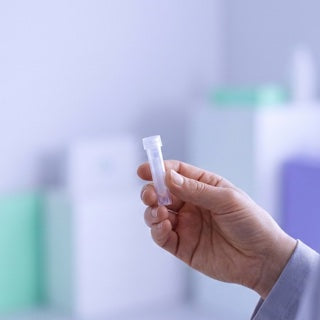 Species-level analysis
Sequencing shows which lactobacillus species are present
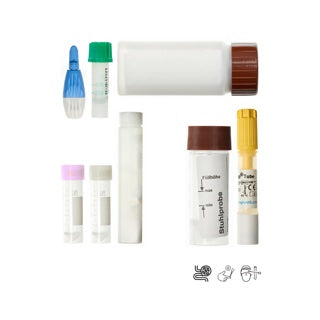 Vaginal type & BV score
Classification into vaginal types I–V, diversity and BV score
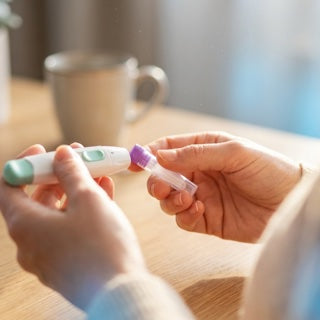 Sample collection at home
Self-collection with the Evalyn Brush, done in a few minutes
 Results consultation included
Evaluation by the ORY expert team
Principle
Measure first, then decide
Without measured values, any treatment is guesswork. We turn the order around: first the lab report, then the decision.

-
01
Measure Vaginal bacterial flora at species level from one swab, analysed at the partner laboratory in Germany.Vaginales Mikrobiom · vaginal swab (Evalyn Brush) · 7–21 days from sample arrival
-
02
See where you stand Every value appears in the lab report with the laboratory's reference range. You can see which values fall inside it and which do not.Lab report including a results consultation
-
03
Targeted instead of general Instead of a standard package you take what your values point to — agreed with the ORY expert team or with your doctor or naturopath.Initial consultation 10 minutes, free
-
04
Measure again after a few months The same analysis a second time shows how the values have changed.Earliest sensible interval: 3 months


Ory experts are there for you
All along the way, doctors and Heilpraktiker from the Ory team are there for you — with your lab report and everything after it.
What a value means and whether a supplement might be an option for you is something to discuss with the ORY expert team or with your doctor or naturopath. This page makes no recommendation and is no substitute for medical assessment.
Details
What this analysis covers
What is measured
The vaginal bacterial flora at species level from a vaginal swab – by sequencing, plus Candida species and the self-measured pH.
The biomarker reference explains what lies behind the numbers: how values interact, which cofactors are involved and which biochemical processes take place in the body — for all values and areas, not only this analysis.
To the biomarker referenceThe values in detail
Lactobacilli too low – what does it mean?
In a large study of almost 400 women without complaints, the vaginal flora was usually dominated by one lactobacillus species. Lactobacilli produce lactic acid and thereby keep the environment acidic (PubMed 20534435). In bacterial vaginosis, lactobacilli decline and anaerobic bacteria, especially Gardnerella, increase sharply (PubMed 37097068).
A low proportion of lactobacilli is not automatically a disease, however: in the same study, some women without complaints also had a flora with few lactobacilli (PubMed 20534435). What the value means for you is clarified in the results consultation.
Lactobacillus crispatus or iners – what is the difference?
The most common vaginal lactobacilli are Lactobacillus crispatus, iners, gasseri and jensenii; vaginal types I, II, III and V are named after the respective dominant species (PubMed 20534435).
Lactobacillus iners plays a special role: it is common in healthy women but is also often found in large amounts in bacterial vaginosis. A systematic review describes it as a transitional species that offers less protection against a disturbed flora than L. crispatus (PubMed 34881196). These are group observations; they do not predict what will happen in your case.
Gardnerella vaginalis detected – what does it mean?
Gardnerella vaginalis is the key bacterium of bacterial vaginosis: in it, Gardnerella forms a coating (biofilm) on the vaginal lining together with other bacteria (PubMed 37097068). The report lists Gardnerella together with other BV-associated bacteria such as Fannyhessea (formerly Atopobium) vaginae, Prevotella, Megasphaera and Mobiluncus.
Detection alone is not a diagnosis: Gardnerella and other anaerobic bacteria also occur in smaller amounts in women without complaints (PubMed 20534435). Bacterial vaginosis is diagnosed by a doctor based on examination and a swab (PubMed 35118003).
Vaginal pH raised – what does it mean?
Lactobacilli keep the vaginal environment acidic with lactic acid. When they decline, the pH rises. A raised pH is described in bacterial vaginosis and even more markedly in aerobic vaginitis (PubMed 28502874).
pH also differs between healthy women, however; in one study, the average in women without complaints was between 4.2 and 5.0 depending on the ethnic group (PubMed 20534435). A single pH value therefore does not show what lies behind it. You measure it with the enclosed test strip and enter it on the request form.
What do vaginal type, species diversity and BV score show?
The vaginal type (community state type, CST) assigns the flora to one of five basic patterns: four each dominated by one lactobacillus species, and type IV with few lactobacilli and more anaerobic bacteria (PubMed 20534435).
Unlike in the gut, low species diversity is the usual state in the vagina; higher diversity can go along with a disturbed flora such as bacterial vaginosis (PubMed 35118003). The BV score is the laboratory's rating based on lactobacilli, the anaerobic accompanying flora and BV-associated bacteria. It is not the same as the clinical Amsel criteria or the Nugent score (PubMed 35118003).
Candida in the swab – is that a yeast infection?
The report checks seven Candida species by qPCR, including Candida albicans and Candida glabrata. Detection is not the same as a yeast infection: in a study from Portugal, 64% of women without complaints carried Candida in the vagina (PubMed 35482711). A yeast infection is only present when complaints and examination fit.
With recurrent yeast infections, the exact Candida species matters for medical treatment (PubMed 26164695). That belongs in a gynaecology practice.
Understanding bacterial vaginosis and the vaginal flora
What is bacterial vaginosis – simply explained?
In bacterial vaginosis, the balance of the vaginal flora is shifted: protective lactobacilli decline and anaerobic bacteria such as Gardnerella increase sharply. It is the most common intimate-area disorder in women of reproductive age and affects about one in four women (PubMed 37097068, PubMed 40537474).
The exact cause has not been clarified (PubMed 40537474). Bacterial vaginosis is diagnosed by a doctor, classically through examination, pH and microscopy (PubMed 35118003), and treated medically.
Why does bacterial vaginosis keep coming back?
After the usual treatment, bacterial vaginosis returns in more than half of women within 3–6 months (PubMed 40537474). The biofilm on the mucosa, resistance and a failure of protective lactobacilli to recolonise are discussed as reasons; newer data also point to sexual transmission (PubMed 40537474, PubMed 37097068).
With recurring complaints, a gynaecology practice is the right place to discuss causes and treatment.
Testing the vaginal flora: self-test, pH strip or gynaecologist?
A pH test strip only shows whether the environment is more or less acidic. Sequencing shows which bacterial species are present in what proportion, including those that are hard to grow on standard culture media, such as Lactobacillus iners (PubMed 34881196). A gynaecological diagnosis of bacterial vaginosis, by contrast, is based on examination, pH and microscopy according to Amsel or Nugent (PubMed 35118003).
A microbiome test can therefore provide additional information but cannot replace an examination when you have complaints.
Complaints and medical assessment
Discharge, odour, itching – which complaints is an altered vaginal flora associated with?
Research describes typical patterns of complaints, although they overlap:
- Thin, greyish-white discharge with a fishy odour: typical of bacterial vaginosis; inflammation with redness is usually absent (PubMed 28502874).
- Yellow-greenish, thicker discharge, redness, burning and pain during sex: described in aerobic vaginitis, an inflammation with gut and skin bacteria instead of lactobacilli (PubMed 28502874).
- Itching and burning: often taken for a yeast infection. In one study, however, only about a third of women who had diagnosed themselves with thrush actually had it; the others had bacterial vaginosis, a mixed infection, something else or a normal finding (PubMed 11864668).
- No complaints: some women without complaints also had a flora with few lactobacilli and many anaerobic bacteria (PubMed 20534435), and Candida was found in many women without complaints (PubMed 35482711).
These are associations from studies, not causes in an individual. The test cannot explain complaints and does not provide a diagnosis. Persistent or new complaints should first be checked in a gynaecology practice.
When should I see a doctor first?
With fever, lower abdominal pain, bleeding outside your period, after sex or after menopause, blisters or sores in the genital area, pain when urinating or strongly foul-smelling discharge, the first step is a gynaecology practice, not a self-test. The same applies if you are or might be pregnant: complaints during pregnancy should always be checked by a gynaecologist. If you may have been exposed to a sexually transmitted infection, have a medical examination.
Do not treat complaints on your own; self-diagnoses in the intimate area are often wrong.
Can the vaginal flora be rebuilt?
This page does not give treatment recommendations, and the report is not a treatment instruction. Whether a result means anything at all and which steps make sense depends on complaints, examination, previous findings and medication. Bacterial vaginosis or a yeast infection is treated by a doctor.
What your report means for you is something to discuss with the ORY expert team or with your doctor or naturopath, for example from the ORY expert network. The results consultation is included in the price.
Who it is for, process and costs
For whom
The test is for anyone who wants their vaginal microbiome analysed at species level. With acute complaints or during pregnancy, a gynaecology practice is the right first step. Whether the measurement suits you can be clarified in the free initial consultation with the ORY expert team or with your doctor or naturopath, for example from the ORY expert network.
What a single value means in your situation is something to discuss with the ORY expert team or with your doctor or naturopath, for example from the ORY expert network. It does not replace medical assessment.
What do I need to consider before the vaginal swab?
Do not use the test during your period, during pregnancy or within three months after a pregnancy. Do not use other vaginal products for at least two days beforehand; vaginal contraceptives, condoms and water-based lubricants are allowed. If you are currently using vaginal medication or antibiotics, agree on the timing with us beforehand and do not stop anything on your own.
Wash your hands thoroughly before collection, do not touch the white bristles, take the sample standing up and turn the pink plunger five times. Measure the pH with the test strip and enter it on the request form. Hand in the shipping bag at a post office as soon as possible, do not put it in a letterbox, and only send it Monday to Thursday.
How it works
Four steps from order to lab report.
- 01 Kit arrives Ships the next working day, postage paid to your door.
- 02 Take the sample You take it yourself at home with the Evalyn Brush.
- 03 Send it in Send it in the postage-paid envelope.
- 04 Get your lab report 7–21 days after the sample arrives.
Instructions
The essentials first:
- Insert the Evalyn Brush as described in the instructions and take the sample with a rotating movement.
- Put the brush back into the transport tube and close it firmly.
- Send it in the postage-paid envelope, as soon as possible after taking the sample.
Please read the instructions carefully. Correct preparation matters: it is what allows your sample – stool, urine, saliva or blood – to be evaluated cleanly and meaningfully.
View full illustrated instructions
Sample report
This is what your result looks like: the full lab report with every Lactobacillus species and dysbiosis organism — shown as an image, no download needed.
View sample report
How long until I get the result?
Analysis usually takes 7–21 days from the arrival of the sample at the laboratory. As soon as your report is ready, we let you know. A results consultation with the ORY expert team is included in the price.
What does the vaginal flora test cost, and does health insurance pay?
The vaginal microbiome test costs €193.21 including VAT, shipping, return postage and results consultation.
Statutory health insurance in Germany generally does not cover microbiome analyses you order yourself. With private insurance, reimbursement may be possible; how it works is described under "Reimbursement by private insurance". If you have complaints, the examination belongs in a gynaecology practice.
Reimbursement by private insurance
For possible reimbursement by your private insurer, this is how it works with us:
Many private insurers cover the cost in full or in part – some not at all. That depends entirely on your policy. We support you through the process as best we can.
Sending your sample back
So that your sample reaches the laboratory safely, please follow the rule for your country.
| Country | Postage | Shipping |
|---|---|---|
| Germany | Already paid | Return postage is prepared, you do not need a stamp. |
| Austria | Add your own postage | To our address in Vienna, not to Germany. |
| Switzerland | Add your own postage | Separate return bag for Switzerland, sent to Germany. |
| Rest of Europe | Add your own postage | Sent to Germany. |
In short: Germany, everything is ready. Austria, add postage and send to Vienna. Switzerland, add postage, special bag, send to Germany. Rest of Europe, add postage and send to Germany.
Family and partner diagnostics
Testing together shows connections that a single analysis does not reveal. We need three things for that.
From three tests of the same analysis for the family you get 10 % off. Write to us and you will receive your own discount code.
Send an email
Which test suits me?
The vaginal microbiome test (€193.21) shows the entire bacterial flora at species level by sequencing, plus Candida species. Vaginal flora with aromatogram (€193.21) uses culture and molecular detection of selected pathogens and also tests in the laboratory how cultured germs react to essential oils. The women's hormone profile (€160.05) measures cycle hormones in saliva.
Which scope makes sense for you can be clarified in the free initial consultation.
Also relevant
Similar analyses
More in depth, or with a different focus.


Which analysis suits you is best discussed in the initial consultation. See all analyses
Supplements
Supplements for the areas this analysis covers
Which product suits you, and in what amount, is something you discuss with the ORY expert team or with your doctor or naturopath after your lab report. This page recommends nothing.


Food supplements are no substitute for a balanced diet. The full range: Supplements
Orientation
What happens next
Five routes, independent of this analysis. The same on every product page.
ORY Berlin sells analyses and products. What a lab report means for you is something a non-medical practitioner or a doctor tells you, not this page.