


Gut diagnostics
Helicobacter pylori stool test – antigen test at home
Detection of Helicobacter pylori antigen in stool – non-invasive, sample at home, analysis in the partner laboratory. With warning signs, see a doctor first.
No prescription needed. Ships the next working day.
| Sample type | Stuhlprobe |
|---|---|
| Method | Antigennachweis |
| Turnaround | 7–21 days from sample arrival |
| Analysis | Partner laboratory in Germany |
 Antigen detection
Components of the bacterium directly in stool
Antigen detection
Components of the bacterium directly in stool
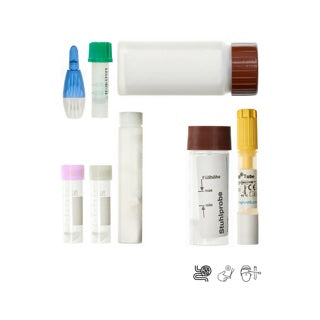 Result positive or negative
Qualitative detection in the partner laboratory
Result positive or negative
Qualitative detection in the partner laboratory
 Sample collection at home
Stool sample with stool catcher and spoon, a few minutes
Sample collection at home
Stool sample with stool catcher and spoon, a few minutes
 Results consultation included
Evaluation by the ORY expert team
Results consultation included
Evaluation by the ORY expert team
The approach
Measure first, then decide
Without measured values, any treatment is guesswork. We turn the order around: first the lab report, then the decision.

-
01
Measure One pathogen test from a stool sample, analysed at the partner laboratory in Germany.Helicobacter pylori Stuhltest · stool sample · 7–21 days from sample arrival
-
02
See where you stand Every value appears in the lab report with the laboratory's reference range. You can see which values fall inside it and which do not.Lab report including a results consultation
-
03
Targeted instead of general Instead of a standard package you take what your values point to — agreed with the ORY expert team or with your doctor or naturopath.Initial consultation 10 minutes, free
-
04
Measure again after a few months The same analysis a second time shows how the values have changed.Earliest sensible interval: 3 months


Ory experts are there for you
All along the way, doctors and Heilpraktiker from the Ory team are there for you — with your lab report and everything after it.
What a value means and whether a supplement might be an option for you is something to discuss with the ORY expert team or with your doctor or naturopath. This page makes no recommendation and is no substitute for medical assessment.
Details
What this analysis includes
What is measured
Detection of Helicobacter pylori antigen in stool.
The biomarker reference explains what lies behind the numbers: how values interact, which cofactors are involved and which biochemical processes take place in the body — for all values and areas, not only this analysis.
To the biomarker referenceThe values in detail
Helicobacter pylori antigen in stool positive – what does it mean?
Helicobacter pylori is a bacterium that can colonise the stomach lining. The test detects components of the bacterium (antigens) in stool. A positive result is an indication that the bacterium is currently present in the stomach. Guidelines count the stool antigen test, together with the urea breath test, among the non-invasive detection methods (PubMed 29999489).
Infection with H. pylori is now generally classified as an infectious disease, regardless of whether there are symptoms (PubMed 35944925). What a positive result means for you and which next steps make sense therefore belongs in a doctor’s practice.
Helicobacter stool test negative – is that certain?
Not always. In a meta-analysis, laboratory antigen tests in adults detected on average around 92% of infections and were correctly negative in around 93% of non-infected people (PubMed 39928545). A small proportion of results is therefore wrong.
Acid blockers (proton pump inhibitors such as pantoprazole), antibiotics and bismuth preparations can influence the result. Whether and for how long you pause them before the test should be clarified with your doctor; do not stop them on your own. If symptoms persist despite a negative result, they should be assessed by a doctor.
What exactly does the test measure – and what not?
The result is qualitative: Helicobacter pylori antigen detectable (positive) or not detectable (negative). The test says nothing about how much the stomach lining has changed, whether there is a stomach ulcer or whether the bacterium is resistant to certain antibiotics. That requires an endoscopy with tissue sample and further examinations.
Understanding Helicobacter pylori
What is Helicobacter pylori – explained simply?
Helicobacter pylori is a bacterium that can live in the stomach lining and cause chronic inflammation of the stomach lining (gastritis). It is considered an important cause of stomach and duodenal ulcers (PubMed 29999489). Many people with H. pylori have no symptoms.
According to a large meta-analysis, around 43% of people worldwide carry the bacterium; frequency has fallen in recent decades and is lower in high-income countries (PubMed 37086739).
Is Helicobacter pylori contagious?
H. pylori is transmitted from person to person, usually in childhood and often within the family. Reviews describe transmission within the household as an important route (PubMed 16798686). Whether family members should be tested is something to discuss with a doctor.
Testing for Helicobacter – stool test, breath test, blood test or endoscopy?
The stool antigen test and the urea breath test are non-invasive; tissue samples during an endoscopy with histology, culture or rapid test are invasive (PubMed 29999489). A blood test for antibodies shows whether there was contact with the bacterium at some point, but not reliably whether it is still present; studies using blood tests therefore report higher frequencies (PubMed 37086739).
If an infection is first found after the age of 50, the German guideline recommends, according to a review, an endoscopy with tissue sample (PubMed 29999489).
Gastritis – what does Helicobacter have to do with it?
Gastritis is inflammation of the stomach lining. The international Kyoto consensus classifies gastritis caused by H. pylori as a separate form and describes how it is distinguished from other causes of stomach complaints (PubMed 26187502). However, gastritis can also have other causes, such as painkillers or alcohol. Whether gastritis is present can only be reliably determined by an endoscopy with a tissue sample; the stool test only shows whether the bacterium is present.
Can I use the stool test as a check after treatment (eradication)?
Whether and when a follow-up test after treatment makes sense is decided by the treating practice. There needs to be a gap between the end of treatment and the test, because antibiotics and acid blockers can distort the result. Agree on the timing with your doctor.
Complaints and medical assessment
Helicobacter pylori symptoms – which complaints are described?
Research associates colonisation with H. pylori with the following complaints and consequences, with varying strength of evidence:
- Inflammation of the stomach lining (gastritis): H. pylori causes chronic gastritis; well documented (PubMed 26187502).
- Upper abdominal complaints such as fullness, pain or nausea (dyspepsia): a separate form of “H. pylori-associated dyspepsia” is described in the consensus (PubMed 26187502); the dyspepsia guideline provides for a non-invasive test in younger patients (PubMed 28631728).
- Stomach and duodenal ulcers: H. pylori is considered an important cause, well documented (PubMed 29999489).
- Iron deficiency and anaemia: more frequent in infected people, observed in a meta-analysis (PubMed 27411077).
Heartburn and belching have many other causes. These are associations from studies, not causes in an individual person. The test cannot explain symptoms and does not provide a diagnosis. Persistent symptoms should first be assessed by a doctor.
When should I see a doctor first?
If you vomit blood or material resembling coffee grounds, have black tarry stools, difficulty swallowing, unintended weight loss, persistent vomiting, anaemia without an obvious cause or a palpable lump in the upper abdomen, the first step is a doctor’s practice or emergency department straight away, not a self-test. The same applies if new stomach complaints appear from around the age of 50: the dyspepsia guideline recommends an endoscopy from the age of 60, and earlier with increased risk, for example in the family (PubMed 28631728).
For severe, sudden upper abdominal pain, call the emergency number 112.
Can Helicobacter pylori be treated?
This page does not give treatment advice. Whether a result means anything at all and which steps make sense depends on your whole situation: symptoms, previous findings, medication and diet. Treating a confirmed infection is a medical decision; guidelines describe combinations of medicines for this and point to increasing antibiotic resistance (PubMed 29999489). Whether treatment worked is tested again afterwards.
What makes sense for you belongs in a conversation with the ORY expert team or with your doctor or naturopath, for example from the ORY expert network. The results consultation is included in the price.
Who it is for, process and costs
Who for
The test is for anyone who would like to have Helicobacter pylori antigen detected in their stool. With warning signs such as vomiting blood, tarry stools or unintended weight loss, the first step is a doctor’s practice. Whether the measurement suits you can be clarified in the free initial consultation with the ORY expert team or with your doctor or naturopath, for example from the ORY expert network.
What a single value means in your situation is something to discuss with the ORY expert team or with your doctor or naturopath, for example from the ORY expert network. This does not replace a medical assessment.
What do I need to consider before the Helicobacter stool test?
Acid blockers (proton pump inhibitors), antibiotics and bismuth preparations can influence the result. Talk to your doctor before the test about whether and for how long you can pause them; do not stop prescribed medication on your own. Fill in the request form completely.
The stool must not come into contact with the toilet bowl or water; a paper stool catcher is included for this. Use the spoon in the lid to take a small amount from several places up to the mark, without overfilling. Label the tube with name, date and time, and do not send it on a Friday or before public holidays.
How it works
Four steps from order to lab report.
- 01 Kit arrives Shipped next working day, postage paid to your door.
- 02 Take the sample Stool sample at home, a few minutes.
- 03 Send it in In the transport tube provided, postage paid to the lab.
- 04 Get your report 7–21 days after the sample arrives, discussion included.
Instructions
The essentials first:
- Take the stool sample with the set provided, avoiding contact with toilet water.
- Close the sample tightly and label it.
- Send it in the postage-paid envelope, as soon as possible after collection.
Please read the instructions carefully. Correct preparation matters, so that your sample – stool, urine, saliva or blood – can be evaluated cleanly and meaningfully.
View full illustrated instructions
How long does it take to get the results?
The analysis usually takes 7–21 days from the time the sample arrives at the laboratory. You will be notified as soon as your report is ready. The results consultation with the ORY expert team is included in the price.
How much does the Helicobacter pylori test cost, and does health insurance pay?
The Helicobacter pylori stool test costs €65 including VAT, shipping, return shipping within Germany and the results consultation.
Statutory health insurance in Germany does not usually cover stool tests that you order yourself. With private insurance, reimbursement may be possible; the process is described under “Reimbursement by private insurance”.
Reimbursement by private insurance
For possible reimbursement by your private insurer, this is how it works with us:
Many private insurers cover the cost in full or in part — some do not cover it at all. That depends entirely on your contract. We will support you through the process as best we can.
Sending your sample back
So that your sample reaches the laboratory safely, please follow this rule for your country.
| Country | Postage | Shipping |
|---|---|---|
| Germany | Already paid | Return postage is prepared, you do not need a stamp. |
| Austria | Add your own postage | To our address in Vienna, not to Germany. |
| Switzerland | Add your own postage | Separate return bag for Switzerland, sent to Germany. |
| Rest of Europe | Add your own postage | Sent to Germany. |
In short: Germany, everything is ready. Austria, add postage and send to Vienna. Switzerland, add postage, special bag, send to Germany. Rest of Europe, add postage and send to Germany.
Family and partner testing
Testing together shows connections that a single analysis does not reveal. We need three things for that.
From three tests of the same analysis for the family you get 10 % off. Write to us and you will get your individual discount code.
Send an email
Which test is right for me?
The Helicobacter pylori stool test (€65) detects the bacterium in stool. For complaints in the bowel rather than the stomach, other tests may be considered, for example the lactose breath test (€65), the gliadin and transglutaminase stool test (€95) or the basic gut profile (€285). With warning signs, none of these is the right first step; see a doctor instead.
Which test makes sense for you can be clarified in the free initial consultation.
Also relevant
Similar analyses
More in depth, or with a different focus.


Which analysis fits you is best discussed in the initial consultation. See all analyses
Supplements
Supplements for the areas this analysis covers
Which product is right for you, and in what amount, is something you discuss with the ORY expert team or with your doctor or naturopath after your lab report. This page recommends nothing.


Food supplements are no substitute for a balanced diet. The full range: Supplements
Orientation
What happens next
Five routes, independent of this analysis. The same on every product page.
ORY Berlin sells analyses and products. What a lab report means for you is something a Heilpraktikerin or a doctor tells you, not this page.