


Gut diagnostics
Gliadin & transglutaminase antibodies (TG2) in stool – gluten
Gliadin and transglutaminase antibodies (TG2) in stool by ELISA – antibody production by the intestinal lining against gluten components. No substitute for coeliac testing in blood; do not eat gluten-free beforehand.
No prescription needed. Ships the next working day.
| Sample type | Stuhlprobe |
|---|---|
| Method | ELISA |
| Turnaround | 7–21 days from sample arrival |
| Analysis | Partner laboratory in Germany |
 Antibodies of the intestinal lining
Secretory IgA against gliadin and transglutaminase 2 in stool
Antibodies of the intestinal lining
Secretory IgA against gliadin and transglutaminase 2 in stool
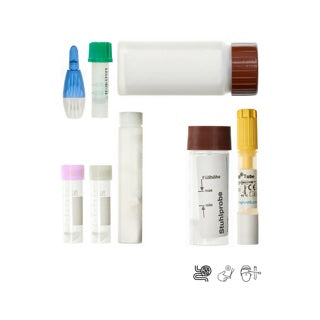 ELISA in the partner laboratory
Two values with the laboratory's reference ranges
ELISA in the partner laboratory
Two values with the laboratory's reference ranges
 Sample collection at home
Stool sample on a gluten-containing diet, a few minutes
Sample collection at home
Stool sample on a gluten-containing diet, a few minutes
 Results consultation included
Evaluation by the ORY expert team
Results consultation included
Evaluation by the ORY expert team
The approach
Measure first, then decide
Without measured values, any treatment is guesswork. We turn the order around: first the lab report, then the decision.

-
01
Measure Two antibody values from one stool sample, analysed at the partner laboratory in Germany.Gliadin & Transglutaminase im Stuhl · stool sample · 7–21 days from sample arrival
-
02
See where you stand Every value appears in the lab report with the laboratory's reference range. You can see which values fall inside it and which do not.Lab report including a results consultation
-
03
Targeted instead of general Instead of a standard package you take what your values point to — agreed with the ORY expert team or with your doctor or naturopath.Initial consultation 10 minutes, free
-
04
Measure again after a few months The same analysis a second time shows how the values have changed.Earliest sensible interval: 3 months


Ory experts are there for you
All along the way, doctors and Heilpraktiker from the Ory team are there for you — with your lab report and everything after it.
What a value means and whether a supplement might be an option for you is something to discuss with the ORY expert team or with your doctor or naturopath. This page makes no recommendation and is no substitute for medical assessment.
Details
What this analysis includes
What is measured
Gliadin and transglutaminase antibodies (TG2) in stool – antibody production by the intestinal lining against gluten components.
The biomarker reference explains what lies behind the numbers: how values interact, which cofactors are involved and which biochemical processes take place in the body — for all values and areas, not only this analysis.
To the biomarker referenceThe values in detail
Transglutaminase antibodies in stool raised – what does it mean?
Tissue transglutaminase 2 (TG2) is an enzyme of the body's own intestinal lining. In coeliac disease, the immune system produces antibodies against this enzyme; IgA antibodies against TG2 in blood are the most important laboratory test in assessing coeliac disease (PubMed 35691302). This test, by contrast, measures antibodies against TG2 in stool, i.e. the antibodies that the lining releases into the gut.
A raised value in stool may be an indication of an immune reaction in the intestinal lining. It is not proof of coeliac disease: stool antibodies are not part of the diagnostic methods in the guidelines, and a study in children found very low sensitivity for the stool test (see below, PubMed 16377644). A conspicuous value belongs with a gastroenterologist.
Gliadin antibodies in stool raised – what does it mean?
Gliadin is a component of the gluten protein found in wheat, spelt, rye and barley. Anti-gliadin antibodies are directed against fragments of this food protein; here they are measured as secretory IgA in stool. A raised value can show that the intestinal lining is producing antibodies against gliadin.
In the European guideline, IgA antibodies against TG2 in blood and tissue samples from the small intestine are at the centre of coeliac diagnostics (PubMed 40999951). In the validation study on stool antibodies, sensitivity for gliadin antibodies was 6% (PubMed 16377644).
Antibodies in stool normal – does that mean I don't have coeliac disease?
No. In a study of 20 children with newly diagnosed coeliac disease and 64 children without it, the stool test for TG2 antibodies detected only 10% and the test for gliadin antibodies only 6% of the children with coeliac disease. The authors considered neither stool test suitable for screening for coeliac disease (PubMed 16377644).
A normal stool result therefore does not rule out coeliac disease. If there is a suspicion, the route is a medical assessment with a blood test on a gluten-containing diet.
Understanding coeliac disease and gluten intolerance
What is coeliac disease – explained simply?
Coeliac disease is an autoimmune disease that mainly affects the small intestine. In people with the corresponding predisposition, gluten triggers an immune reaction that can damage the intestinal lining. About 1% of the population is affected, with a range of 0.5 to 2% (PubMed 35691302). Many affected people do not know it (PubMed 31210940).
The diagnosis is based on antibodies in blood (IgA against TG2) and evidence of damage to the lining in tissue samples from the small intestine (PubMed 35691302). For selected adults with very high blood values, the 2025 European guideline also describes a route without a tissue sample under certain conditions (PubMed 40999951). Both belong with a gastroenterologist.
Coeliac disease, gluten sensitivity or wheat allergy – what is the difference?
Coeliac disease is an autoimmune disease with antibodies against TG2 and damage to the lining (PubMed 35691302). Non-coeliac gluten sensitivity describes symptoms after gluten-containing foods without coeliac disease and without wheat allergy. There is no biomarker for it; it is identified by ruling out other causes. A review describes that in controlled studies, symptoms are actually triggered by gluten in only some of the people who report gluten intolerance (PubMed 41138740). A wheat allergy is an allergic reaction via IgE antibodies and is examined with other methods.
This stool test does not measure IgE antibodies and cannot determine gluten sensitivity.
Coeliac test: blood or stool – what is the standard?
The standard is a blood test for IgA antibodies against TG2 on a gluten-containing diet, followed by tissue samples from the duodenum; the European guideline specifies at least four samples for this (PubMed 40999951). Antibodies in stool are not part of this guideline pathway.
We still offer the stool test because it reflects antibody production in the lining itself. But we say openly: according to the available studies, it is not suitable for the question “Do I have coeliac disease?” (PubMed 16377644). A positive result should be investigated further by a gastroenterologist, if necessary with a small-intestine biopsy.
Is the stool test meaningful on a gluten-free diet?
According to the available studies, no. Antibodies arise as a reaction to gluten; on a gluten-free diet they decline. In the validation study, the stool tests in children remained negative after the start of a gluten-free diet, apart from two single values (PubMed 16377644). The guideline requires all tests to be performed on a gluten-containing diet (PubMed 31210940).
Important: do not eat gluten-free before a medical assessment. The tests for coeliac disease, antibodies in blood and tissue samples from the small intestine, are only meaningful on a gluten-containing diet (PubMed 31210940). Anyone who avoids gluten beforehand risks falsely normal results. This also applies to this stool test: keep to your usual gluten-containing diet in the weeks before the sample.
Anyone who has been living gluten-free for some time should discuss the approach with a doctor or with ORY beforehand; the 2025 guideline describes specific pathways for this situation (PubMed 40999951).
Complaints and medical assessment
Coeliac disease symptoms – which complaints are described?
Coeliac disease presents very differently: there are classic gastrointestinal complaints, complaints outside the gut and courses without any symptoms (PubMed 35691302). Described in research, with varying strength of evidence:
- Gastrointestinal complaints such as diarrhoea, bloating or abdominal pain: described as classic complaints, well documented (PubMed 35691302).
- Iron deficiency and anaemia: the most common sign outside the gut, described in 12 to 82% of newly diagnosed people (PubMed 34067622).
- Itchy blistering rash (dermatitis herpetiformis): a skin form of coeliac disease, well documented (PubMed 27499257).
- Bone loss (osteoporosis): described as a possible consequence (PubMed 35691302).
- Neurological complaints such as unsteady gait (ataxia): covered in the guideline as gluten-related disorders, little evidence (PubMed 31210940).
These are associations from studies, not causes in an individual person. The stool test cannot explain symptoms and does not provide a diagnosis. Persistent symptoms should first be assessed by a doctor, and suspected coeliac disease by a gastroenterologist.
When should I see a doctor first?
If coeliac disease is suspected, the first step is a doctor’s practice: a blood test on a gluten-containing diet and, if the result is conspicuous, a gastroenterologist. This applies especially with unintended weight loss, persistent diarrhoea, iron deficiency without an obvious cause, in children with poor growth, or if coeliac disease runs in the family. With blood in the stool or black stool, fever, severe abdominal pain, persistent vomiting or difficulty swallowing, also see a doctor immediately.
Important: do not eat gluten-free before a medical assessment. The tests for coeliac disease, antibodies in blood and tissue samples from the small intestine, are only meaningful on a gluten-containing diet (PubMed 31210940). Anyone who avoids gluten beforehand risks falsely normal results. This also applies to this stool test: keep to your usual gluten-containing diet in the weeks before the sample.
Can coeliac disease be treated?
This page does not give treatment advice. Whether a result means anything at all and which steps make sense depends on your whole situation: symptoms, previous findings, medication and diet. Treating diagnosed coeliac disease is a medical task and, according to the guideline, requires education and follow-up (PubMed 31210940). Going gluten-free on your own before the assessment makes diagnosis more difficult.
What makes sense for you belongs in a conversation with the ORY expert team or with your doctor or naturopath, for example from the ORY expert network. The results consultation is included in the price.
Who it is for, process and costs
Who for
The test is for anyone who would like to have antibodies against gliadin and transglutaminase measured in their stool, on a gluten-containing diet. If coeliac disease is suspected, the first step is a medical assessment with a blood test. Whether the measurement suits you can be clarified in the free initial consultation with the ORY expert team or with your doctor or naturopath, for example from the ORY expert network.
What a single value means in your situation is something to discuss with the ORY expert team or with your doctor or naturopath, for example from the ORY expert network. This does not replace a medical assessment.
What do I need to consider before the stool test?
In the weeks before the sample, do not follow a gluten-free diet: antibodies can only be detected with normal gluten intake. If you have been living gluten-free for some time, talk to ORY before the test. Use the collection stick to take a pea-sized amount of stool from several places, stir it into the tube and close it tightly; the sample must not come into contact with water or urine.
Store the tube in the fridge until shipping (2–8 °C, do not freeze) and send it on the same or next day if possible, only from Monday to Thursday.
How it works
Four steps from order to lab report.
- 01 Kit arrives Shipped next working day, postage paid to your door.
- 02 Take the sample Stool sample at home, a few minutes.
- 03 Send it in In the transport tube provided, postage paid to the lab.
- 04 Get your report 7–21 days after the sample arrives, discussion included.
Instructions
The essentials first:
- Take the stool sample with the set provided, avoiding contact with toilet water.
- Close the sample tightly and label it.
- Send it in the postage-paid envelope, as soon as possible after collection.
Please read the instructions carefully. Correct preparation matters, so that your sample – stool, urine, saliva or blood – can be evaluated cleanly and meaningfully.
View full illustrated instructions
Sample report
This is what your result looks like: the full lab report with both antibody values — shown as an image, no download needed.
View sample report
How long does it take to get the results?
The analysis usually takes 7–21 days from the time the sample arrives at the laboratory. You will be notified as soon as your report is ready. The results consultation with the ORY expert team is included in the price.
How much does the test cost, and does health insurance pay?
The gliadin and transglutaminase stool test costs €95 including VAT, shipping, return shipping within Germany and the results consultation.
Statutory health insurance in Germany does not usually cover stool analyses that you order yourself. With private insurance, reimbursement may be possible; the process is described under “Reimbursement by private insurance”.
Reimbursement by private insurance
For possible reimbursement by your private insurer, this is how it works with us:
Many private insurers cover the cost in full or in part – some not at all. That depends entirely on your policy. We support you through the process as best we can.
Sending your sample back
So that your sample reaches the laboratory safely, please follow this rule for your country.
| Country | Postage | Shipping |
|---|---|---|
| Germany | Already paid | Return postage is prepared, you do not need a stamp. |
| Austria | Add your own postage | To our address in Vienna, not to Germany. |
| Switzerland | Add your own postage | Separate return bag for Switzerland, sent to Germany. |
| Rest of Europe | Add your own postage | Sent to Germany. |
In short: Germany, everything is ready. Austria, add postage and send to Vienna. Switzerland, add postage, special bag, send to Germany. Rest of Europe, add postage and send to Germany.
Family and partner testing
Testing together shows connections that a single analysis does not reveal. We need three things for that.
From three tests of the same analysis for the family you get 10 % off. Write to us and you will get your individual discount code.
Send an email
Which test is right for me?
If coeliac disease is suspected, the appropriate first step is a blood test at a doctor’s practice, not a stool test. The gliadin and transglutaminase stool test (€95) shows antibodies released by the intestinal lining. For complaints after milk or fruit sugar there are the lactose breath test and the fructose absorption analysis (€65 each), for histamine the histamine stool test (€55); the basic gut profile (€285) offers a broader look at gut flora and the gut barrier.
Which test makes sense for you can be clarified in the free initial consultation.
Also relevant
Similar analyses
More in depth, or with a different focus.


Which analysis suits you is best discussed in the initial consultation. See all analyses
Supplements
Supplements for the areas this analysis covers
Which product suits you, and in what amount, is something you discuss with the ORY expert team or with your doctor or naturopath after your lab report. This page recommends nothing.


Food supplements are no substitute for a balanced diet. The full range: Supplements
Orientation
What happens next
Five routes, independent of this analysis. The same on every product page.
ORY Berlin sells analyses and products. What a lab report means for you is something a non-medical practitioner or a doctor tells you, not this page.